


















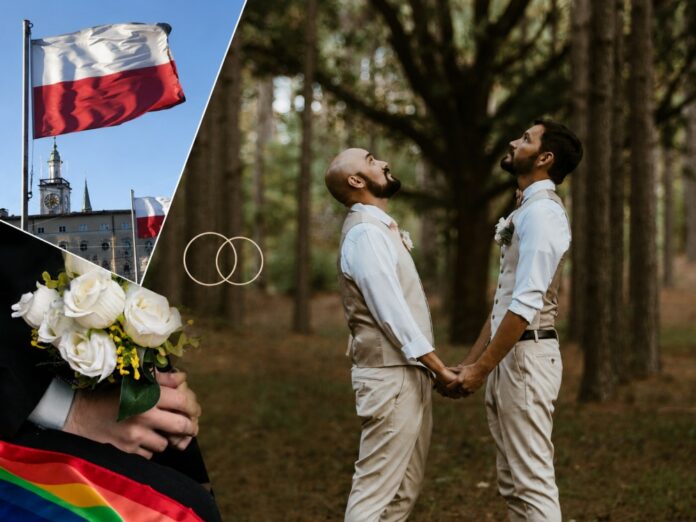
Poland has begun allowing same-sex couples married overseas to apply to have their marriages officially recorded in the country’s civil registry, marking a significant shift in LGBTQ+ recognition.
New administrative rules came into effect on 23 August, introducing civil registry forms capable of accurately recording marriages between two women or two men.
The Ministry of Digital Affairs says same-sex couples with a foreign marriage certificate can now apply for transcription into the Polish register.
The process appears broader than the European court case that prompted the reform. It can extend to marriages performed outside the European Union, although additional documentation, legalisation or an apostille may be required.
Same-sex couples still cannot marry within Poland itself, meaning the change falls well short of full marriage equality.
European Court Ruling Forced Poland To Act
The reform follows a landmark November 2025 judgment from the Court of Justice of the European Union.
The case involved Polish nationals Jakub Cupriak-Trojan and Mateusz Trojan, who legally married in Germany after exercising their right to live elsewhere in the European Union.
Polish authorities refused to transcribe their German marriage certificate because domestic law does not allow two people of the same sex to marry.
The EU court ruled that Poland could not refuse recognition where doing so interfered with the couple’s freedom of movement and their right to family life.
Importantly, the judgment concerned a marriage lawfully entered into in another EU member state.
It did not require Poland to introduce same-sex marriage domestically. Instead, it required Polish authorities to recognise the couple’s existing marriage when transcription was the only available method of doing so.
Poland’s Supreme Administrative Court subsequently ordered officials to register the couple’s German marriage.
Warsaw issued Poland’s first transcription of a same-sex marriage certificate in May, with other cities beginning to follow.
New Rules Appear Broader Than The Original Case
The administrative system introduced on 23 August appears to go beyond the specific circumstances examined by the EU court.
Rather than limiting applications to marriages performed elsewhere in the European Union, the Ministry of Digital Affairs has said couples married abroad can seek transcription of their foreign marriage certificates.
Polish consular guidance also covers civil-status documents issued outside the EU.
Depending on the country involved, couples may need to provide:
- The original foreign marriage certificate
- An official Polish translation
- An apostille or other form of legalisation
- Additional civil-status documents requested by officials
That means a same-sex couple married in a country outside the European Union can apply for Polish transcription, provided their documents meet the applicable requirements.
However, the ability to apply should not be interpreted as a guarantee that every case will proceed without legal or administrative complications.
New Forms Remove A Major Administrative Barrier
One of the practical barriers had been the design of Poland’s existing marriage-registration system.
Previous templates were structured around a marriage between a “woman” and a “man”, making it impossible to record two female or two male spouses accurately.
Some cities had already begun registering foreign same-sex marriages by placing one spouse in an incorrectly gendered section of the document.
The new forms allow officials to accurately register a marriage involving a woman and a man, two women or two men.
Deputy Prime Minister and Digital Affairs Minister Krzysztof Gawkowski described the reform as an important step towards greater equality, dignity and certainty for Polish citizens.
Civil registry offices across Poland are now expected to use the updated system when processing eligible applications.
What Does Transcription Actually Mean?
Transcription creates a Polish civil-status record based on a marriage certificate issued by another country.
That gives the couple a Polish document confirming that the overseas marriage occurred and allows their marital status to be reflected in the country’s official records.
For same-sex couples, this can make it easier to prove their relationship when dealing with public authorities and other institutions.
However, transcription does not necessarily resolve every question about the rights attached to that marriage.
Because Polish domestic law still does not provide for same-sex marriage or civil partnerships, uncertainty remains around how registered foreign marriages will be treated in areas such as taxation, inheritance, property and other family rights.
Further court cases or legislation may be needed to establish the full legal consequences.
The reform therefore provides official recognition of an existing marriage without necessarily granting couples every right automatically enjoyed by mixed-sex spouses under Polish law.
Same-Sex Couples Still Cannot Marry In Poland
The new rules do not allow two women or two men to marry in Poland.
Polish law continues to define marriage domestically as a union between a woman and a man.
Couples wanting their relationship recognised under the new process must first marry in another country where same-sex marriage is legal and then apply to have that foreign certificate transcribed.
The result creates a striking divide.
Poland will now record many same-sex marriages performed elsewhere while continuing to prevent those marriages from taking place on Polish soil.
President Vetoed Separate Partnership Legislation
Attempts to give unmarried couples greater rights under Polish domestic law have also faced political resistance.
In July, President Karol Nawrocki vetoed legislation that would have allowed unmarried couples, including same-sex couples, to enter legally recognised agreements.
The proposed system would have covered rights involving joint property, taxation, inheritance, medical information and decisions following a partner’s death.
It would have represented Poland’s first domestic legal recognition of same-sex relationships.
Nawrocki argued that the legislation would undermine the special constitutional status of marriage as a union between a woman and a man.
His veto means same-sex couples living in Poland still have no nationally recognised civil partnership system available to them.
A Significant But Limited Step
For Polish same-sex couples who have married overseas, the new process could remove years of legal and administrative uncertainty.
It also creates a potentially broader pathway than the original EU court ruling by allowing applications involving marriage certificates issued beyond the European Union.
But the limits remain substantial.
Same-sex couples cannot marry in Poland, the country has no domestic civil partnership framework and the full legal consequences of transcribing an overseas marriage remain unsettled.
That makes the reform an important step towards equality — but not marriage equality itself.
Focus Keyphrase:
The news team for Gay Nation love tips from our readers. Got tips or a news story that you would like published? Go here to tell us something.
Visit the Gay Nation store Now