



















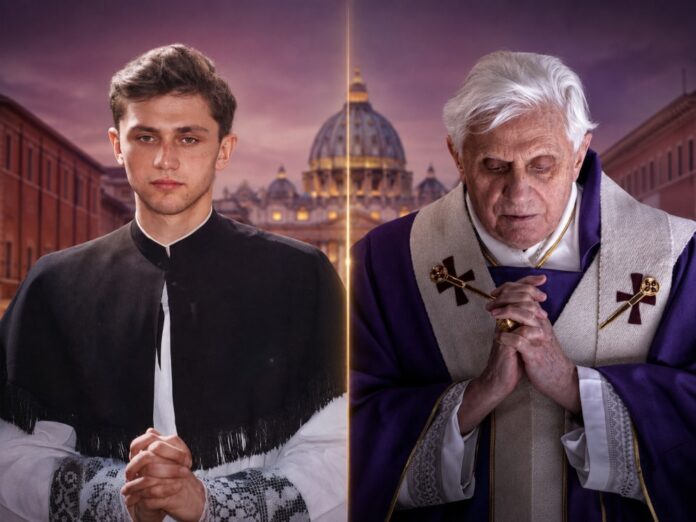
A colourised photograph of a young Pope Benedict XVI has sent the queer internet into meltdown, with reactions landing somewhere between “Vatican heartthrob”, “Benedictwink” and “evil twink”.
The portrait of Joseph Ratzinger, believed to date from the 1950s, resurfaced on X alongside a comparison showing him later in life.
With his carefully styled hair, intense gaze and suspiciously strong face card, the future pope quickly became the subject of admiration, disbelief and some gloriously irreverent historical commentary.
“Imagine wasting your life dedicated to religion looking like this,” one person wrote.
“Give up sex with that facecard? The mindset he had, holy smokes,” another added.
Others were less dazzled by the cheekbones.
“I can recognise an evil twink when I see one,” one user declared.
“I know a demon when I see one,” wrote another.
Perhaps the most efficient response simply renamed him: “Benedictwink.”
Is The Viral Pope Benedict Photo Real?
The polished appearance of the photograph led some social media users to suspect it had been generated using artificial intelligence.
However, a black-and-white version of the portrait has circulated online for years, well before the current explosion of generative AI imagery.
The viral colour version appears to be a colourised and potentially retouched reproduction of that older photograph, rather than an entirely invented face.
That distinction matters.
Digital colourisation and restoration can change skin texture, eye colour, lighting and contrast, sometimes making historical subjects look far more contemporary than they do in an untouched archival photograph.
The result can feel uncannily modern — which may explain why young Ratzinger suddenly looks less like a mid-century seminarian and more like someone about to launch an extremely problematic fashion campaign.
Still, the underlying portrait appears to be considerably older than the viral post.
The internet did not invent young Joseph Ratzinger’s face. It simply rediscovered it, added colour and immediately made it queer discourse.
From Young Priest To Pope Benedict XVI
Joseph Ratzinger was ordained as a Catholic priest in 1951 before establishing himself as a prominent theologian and senior Vatican official.
From 1981 until his election as pope in 2005, he led the Congregation for the Doctrine of the Faith, the Vatican body responsible for defending and enforcing Catholic teaching.
That position earned him a reputation as the Church’s doctrinal enforcer.
Ratzinger became Pope Benedict XVI in April 2005 and remained in the role until his resignation in 2013. He was the first pope in centuries to voluntarily step down.
He died in December 2022 at the age of 95.
While the viral photograph has inspired plenty of playful thirst, Benedict’s record on LGBTQ+ people was anything but harmless.
Benedict’s Damaging Record On LGBTQ+ People
As head of the Congregation for the Doctrine of the Faith, Ratzinger signed a deeply influential 1986 letter addressing homosexuality.
The document claimed that a homosexual orientation should be viewed as an “objective disorder” and described same-sex intimacy as morally unacceptable.
That language has had a lasting and damaging impact on LGBTQ+ Catholics, particularly those attempting to reconcile their sexuality with their faith.
After becoming pope, Benedict approved a 2005 Vatican instruction restricting who could be admitted to seminaries and ordained as priests.
The document said the Church could not admit candidates who practised homosexuality, had what it called “deep-seated homosexual tendencies”, or supported “gay culture”.
It was not an absolute prohibition covering every gay man. The instruction distinguished those categories from what it described as “transitory” tendencies that had supposedly been overcome for at least three years.
Nevertheless, the policy formalised sweeping discrimination against gay candidates and reinforced the idea that homosexuality was incompatible with religious leadership.
Benedict also remained a prominent defender of the Catholic Church’s opposition to marriage equality and same-sex relationships throughout his papacy.
So while the newly rediscovered portrait may be serving face, the beliefs Ratzinger promoted caused genuine harm.
What About His Hitler Youth History?
Some of the darker jokes about the photograph also referenced Ratzinger’s childhood in Nazi Germany.
Ratzinger was registered in the Hitler Youth as a teenager, although the historical context is important.
Membership had become compulsory for German boys of his age. Ratzinger later said he did not want to participate, avoided attending meetings and grew up in a Catholic family opposed to the Nazi regime.
At 16, he was drafted into an anti-aircraft unit before later being conscripted into the German infantry.
As the Second World War neared its end in 1945, Ratzinger deserted and returned to his family home. He was subsequently captured by American forces and briefly held as a prisoner of war.
His registration should therefore not be casually presented as evidence that he was an enthusiastic Nazi supporter.
The documented history is more complicated: a teenager living under a dictatorship, compulsory enrolment, military conscription and eventual desertion.
There is already more than enough in Benedict’s adult record to criticise without stripping the wartime history of its context.
Why ‘Benedictwink’ Struck A Nerve
The fascination with the photograph comes partly from the enormous contrast between the young man in the image and the severe public figure many people remember.
Pope Benedict became known for traditional Catholic doctrine, elaborate vestments and opposition to reforms sought by LGBTQ+ Catholics.
Seeing that same person as a striking young man has created exactly the kind of historical whiplash the queer internet loves.
It also allows LGBTQ+ people to take an institution associated with shame, repression and moral judgement and briefly turn one of its most powerful former leaders into a meme.
For queer Australians raised in Catholic families or schools, the humour may carry an additional layer.
The jokes are not simply about finding a young pope attractive. They are also about reclaiming the right to look irreverently at a religious hierarchy that spent decades passing judgement on queer people’s identities, relationships and bodies.
Attraction does not erase history, and a strong face card is not absolution.
The photograph may have given the internet “Benedictwink”, but Benedict’s anti-LGBTQ+ legacy remains considerably harder to colourise into something flattering.
The news team for Gay Nation love tips from our readers. Got tips or a news story that you would like published? Go here to tell us something.
Visit the Gay Nation store Now