














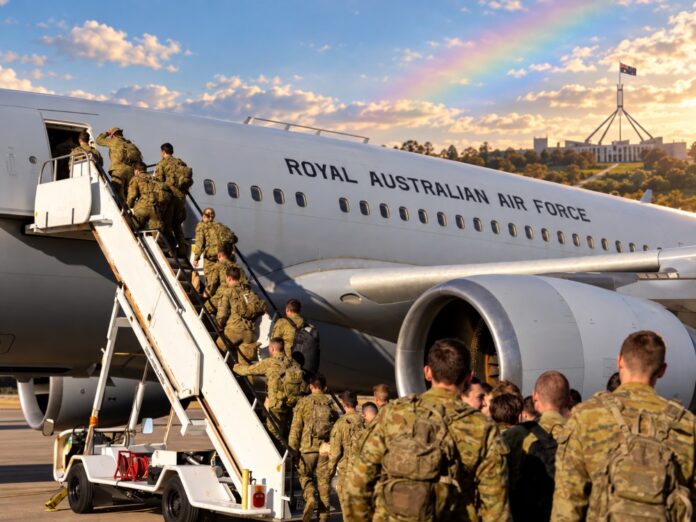
The Australian Government has committed to formally apologising to LGBTQ+ Defence personnel and veterans harmed by decades of discriminatory military policies.
The long-awaited recognition follows the passage of legislation allowing eligible historical homosexual service offences to be extinguished.
Veterans affected by discriminatory separations will also be able to receive official recognition through corrected Defence records and a Certificate of Honourable Service.
However, the reforms do not establish a financial redress scheme for people who lost careers, income, housing and their mental wellbeing because of the Australian Defence Force’s former policies.
It is another significant step towards recognising the injustice inflicted on LGBTQ+ service members—but advocates warn that recognition without material redress remains incomplete.
Government Commits To Formal Apology
The commitment was announced as Parliament passed the Defence Force Discipline Amendment (RCDVS Implementation and Related Measures No. 1) Bill 2026 on 17 September.
Speaking in the Senate, Minister Jenny McAllister said the government would formally acknowledge those harmed.
“The government will make a formal apology, acknowledging the harm experienced by LGBTIQA+ personnel and veterans as a result of historical discriminatory practices at the appropriate time.”
The government has not yet announced when the apology will occur, who will deliver it or the precise form it will take.
Advocates are calling for it to be delivered in Parliament by Prime Minister Anthony Albanese, rather than being limited to a statement from Defence officials or a government minister.
Historical Convictions Can Be Extinguished
The legislation creates a process through which certain historical service convictions involving consensual same-sex activity can be extinguished.
Before the ban on gay and lesbian military personnel was lifted in 1992, Australian service members could be investigated and punished because of their sexuality.
Some faced formal charges and convictions under military law.
Others were interrogated, placed under surveillance, discharged on administrative grounds, pressured to resign or quietly denied the opportunity to continue their careers.
The distinction is important because a scheme focused exclusively on criminal or disciplinary convictions would exclude many of the people harmed by the former policies.
An administrative discharge could be every bit as devastating as a conviction, even if it left a different paper trail.
Recognition Extends Beyond Those Convicted
The government’s response provides for Defence records to recognise separations connected with historical discriminatory policies.
That administrative recognition is expected to extend to veterans who were targeted because of their sexual orientation or gender identity, including people who were never formally convicted of an offence.
GRAI chair David Gibson said ensuring those veterans were not excluded had been one of the organisation’s central concerns.
“When GRAI appeared before the Senate inquiry, our concern was pretty simple. If we recognised the convictions but not the people dealt with administratively, we risked creating another group of forgotten veterans,” Gibson said.
“That distinction matters. Some people were convicted. Some were discharged. Some were pressured to leave. Whatever the mechanism, the message they received was the same: there was no place for them in the Defence Force because of who they were.”
The proposed Certificate of Honourable Service would provide formal acknowledgement that their service remained honourable, regardless of the discriminatory circumstances under which it ended.
David Gibson Was Forced Out Of The Army
For Gibson, the issue is deeply personal.
He served in the Australian Army during the 1980s and has described military efforts to identify gay and bisexual personnel as “witch hunts”.
Gibson was interrogated about his sexuality and pressured to identify other people suspected of being gay, lesbian or bisexual.
He was discharged in 1989 after the military discovered he was bisexual.
His experience demonstrates why limiting recognition to people with criminal convictions would fail to capture the full extent of the injustice.
Military authorities often relied on administrative procedures to remove LGBTQ+ personnel without formally prosecuting them.
Those veterans still lost their careers, livelihoods and connection to a profession they had chosen to serve.
Apology Should Come From The Prime Minister
Gibson welcomed the government’s commitment but said the apology must recognise that the discrimination was institutional.
“These were not the actions of a few individuals. They were laws, regulations and policies of the Australian state,” Gibson said.
“Defence acknowledging its history matters enormously. But the apology needs to come from the nation, through the Prime Minister.
“It needs to say plainly: you served Australia, what was done to you was wrong, and we are sorry.”
A prime ministerial apology delivered in Parliament would give the acknowledgement national significance.
It would also make clear that those harmed were not victims of isolated prejudice or misconduct by individual officers.
They were subjected to policies formally adopted and enforced by the state.
Financial Redress Remains Absent
While community organisations have welcomed the apology, the government has not agreed to compensate those affected.
Just.Equal Australia spokesperson Rodney Croome said financial redress was necessary to recognise the tangible consequences of discrimination.
“We welcome an apology as an important step towards healing the wounds of the past,” Croome said, “but financial redress is also required for those who suffered discrimination and dishonourable discharge because of who they were.
“LGBTIQA+ veterans who faced discrimination, including dishonourable discharge, suffered the loss of employment, income and sometimes housing, a loss of self confidence and sometimes severe impacts on mental health.”
For some veterans, dismissal meant losing not only a wage but also accommodation, training, promotion prospects, retirement benefits and an entire planned career.
Others lost the identity, purpose and community associated with military service.
An apology can recognise that harm, but it cannot replace the income or opportunities taken away.
‘Apologies Matter, But So Does Redress’
Greens LGBTQIA+ spokesperson Senator Nick McKim also called for the apology to be delivered by both the Prime Minister and the Chief of the Australian Defence Force.
He said the government should establish an inquiry to determine how financial redress should operate.
“People lost employment, income and housing, and many suffered profound impacts on their mental health,” McKim said.
“Financial redress cannot undo that harm, but it would provide a tangible acknowledgement of the injustices that were inflicted.
“Canada and the United Kingdom have redress schemes for LGBTIQA+ former service personnel, and Australia should follow their lead. The Government should establish an inquiry to determine the appropriate amount of redress and how it should be provided.
“Apologies matter, but so does the acknowledgment of harm through the provision of redress.”
Canada and the United Kingdom have both introduced schemes providing payments to former LGBTQ+ military personnel affected by discriminatory policies.
Tasmania has also become the first Australian jurisdiction to provide financial redress to people charged or convicted under its former laws criminalising homosexuality and so-called cross-dressing.
Advocates argue those examples give Australia workable models for recognising the financial and personal damage suffered by veterans.
Australia’s History Of Military Discrimination
The Australian military prohibited gay and lesbian people from serving openly until November 1992.
Before the ban was lifted, personnel could be investigated, interrogated, disciplined or discharged because of actual or suspected same-sex relationships.
The consequences extended far beyond leaving the military.
A dishonourable or involuntary discharge could affect future employment, housing, relationships and mental health.
Some veterans concealed the true reason their service ended for decades because of shame or fear of further discrimination.
Transgender Australians faced separate exclusionary policies and were not formally permitted to serve openly until 2010.
The experiences of LGBTQ+ personnel were later examined by the Royal Commission into Defence and Veteran Suicide, which heard evidence about discrimination and its lasting consequences.
A subsequent Senate inquiry recommended restorative measures, including an apology, recognition of honourable service and changes to historical records.
Veterans Should Not Have To Wait Again
GRAI has cautioned that debate over compensation should not delay the apology or reforms already promised.
“There may be more work to do on redress. That should not stop us doing what we already know needs to be done,” Gibson said.
“We have had the Royal Commission into Defence and Veteran Suicide. We have had submissions, evidence from veterans and a Senate inquiry into this legislation.
“We do not need another inquiry to tell us that the discrimination happened.
“For older veterans in particular, time is not an abstract thing. Some have waited decades for this acknowledgement. Others did not live to see it. So let’s not make them wait again.”
That urgency is central to the campaign.
Many affected veterans are now older. Some have spent more than three decades waiting for the country they served to acknowledge what was done to them.
The apology and Certificates of Honourable Service will matter.
They will confirm that these veterans served Australia with dignity, even when Australia failed to treat them with the same dignity in return.
But until financial redress is addressed, the government’s response will remain unfinished.
The news team for Gay Nation love tips from our readers. Got tips or a news story that you would like published? Go here to tell us something.
Visit the Gay Nation store Now