

















Former AFL player Mitch Brown is bringing queer desire onto the footy field in the sweaty, sexy music video for Australian pop artist ANDY’s new single, “Can’t Wait”.
Brown, who made history in 2025 as the first male AFL player, past or present, to come out publicly as bisexual, takes centre stage as ANDY’s love interest.
The sport-themed video also features Australian rugby league legend Ian Roberts, who became the first high-profile Australian sportsman to come out publicly as gay in 1995.
Together, Brown and Roberts bring two generations of groundbreaking LGBTQ+ sporting representation into a video that transforms Australian footy’s physicality into something openly queer.
Mitch Brown Plays ANDY’s Love Interest
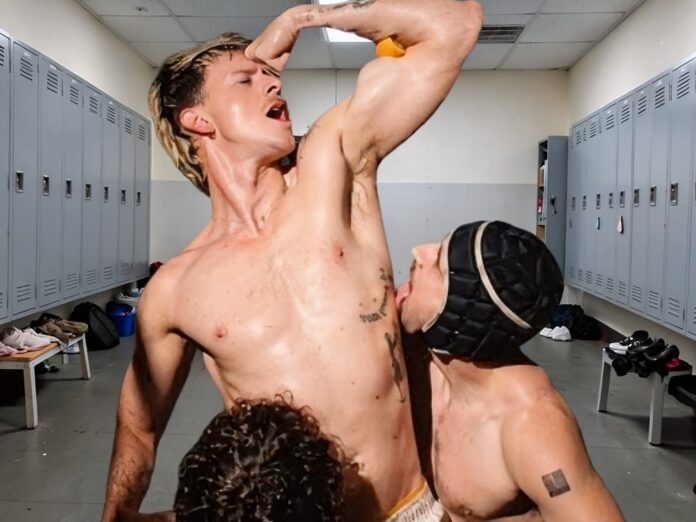
“Can’t Wait” draws on the familiar imagery of Australian sport: bodies colliding, players grappling, sweat, mud and the intense physical closeness routinely accepted on the field.
The video then asks what changes when that contact is presented as desire.
Brown plays ANDY’s love interest, culminating in an on-field kiss that would have been almost unimaginable during his decade playing professional AFL.
“I spent so much of my playing career being conscious of what I said, how I behaved and what people might assume about me, and now I’m on a footy field – although a different code – kissing another man for a music video.
“There’s a nice full-circle feeling to that.”
For Brown, the scene is more than a provocative pop-video moment.
It directly reverses the self-monitoring he experienced during his playing career, when he felt pressure to manage his words, behaviour and relationships in case teammates or supporters questioned his sexuality.
‘You Could Hear A Pin Drop’
The emotional weight of the footage was also clear to those working behind the camera.
“Honestly, when we filmed them and watched it back for the first time, you could hear a pin drop,” ANDY said.
“I think everyone could feel that we were commenting on something very real, very raw and very beautiful.”
The video uses the visual language of sport without treating queerness as something separate from it.
Instead, desire exists alongside the strength, competition and physical intensity traditionally associated with football.
That approach challenges the contradiction at the heart of many men’s sporting cultures.
Players are encouraged to tackle, embrace, pile onto one another and celebrate with enormous physical affection. Yet similar contact can suddenly become controversial when it is openly romantic or queer.
As ANDY’s project puts it, the contact was never the problem.
The perceived sexuality behind it was.
Brown Made AFL History In 2025
Brown played 94 games for the West Coast Eagles between 2007 and 2016.
He publicly came out as bisexual in August 2025, becoming the first male AFL player, current or retired, to do so.
His announcement broke new ground in a competition that had never previously had a male player publicly identify as gay or bisexual.
Brown described spending much of his career surrounded by a hypermasculine culture in which homophobic language was commonplace.
He also acknowledged remaining silent when he heard offensive comments because he feared that speaking up might cause people to question his own sexuality.
Since coming out, Brown has used his platform to advocate for greater LGBTQ+ inclusion and challenge homophobia and biphobia within Australian sport.
Appearing in “Can’t Wait” takes that advocacy into a dramatically more visible space.
Brown is no longer simply discussing the fear that kept him guarded during his AFL career. He is openly performing queer intimacy on a football field.
Ian Roberts Brings Another Generation Of History
Ian Roberts’ appearance gives the video an additional layer of Australian sporting history.
The former South Sydney, Manly and North Queensland rugby league player came out publicly as gay in 1995.
At the time, Roberts was one of the most recognisable and physically formidable athletes in Australian sport.
His decision challenged stereotypes suggesting gay men could not belong within traditionally masculine sporting environments.
Roberts endured homophobia and intense media attention, but his visibility became a landmark moment for LGBTQ+ athletes in Australia and internationally.
More than three decades later, openly gay and bisexual male players remain extraordinarily rare across Australia’s leading men’s sporting competitions.
Placing Roberts alongside Brown connects two very different moments.
Roberts came out while still competing professionally in an era when open homophobia was widespread and often unquestioned.
Brown came out years after retiring, explaining that the culture surrounding the AFL had made honesty feel impossible while he was playing.
Their presence in the same music video celebrates progress while making clear how slowly change has arrived.
Queering Australian Sporting Culture
The decision to set “Can’t Wait” within a footy environment is particularly significant for Australian audiences.
Football codes occupy an enormous place in the country’s identity, shaping ideas about masculinity, belonging and what Australian men are expected to look and act like.
Queer people have always played, coached, supported and worked within those sports.
What has often been missing is the freedom to be visible.
Women’s competitions have generally moved further towards embracing LGBTQ+ identities, with openly queer players and Pride initiatives now forming a prominent part of leagues including the AFLW.
Elite men’s sport has remained far more resistant.
The contrast is particularly stark in the AFL, where Brown remains the only male player from the competition’s history to have publicly identified as gay or bisexual.
“Can’t Wait” does not solve that absence.
What it does is show the imagery of Australian football being reclaimed and reimagined by queer people rather than surrendered to a culture of silence.
More Than A Sexy Music Video
The video is undeniably designed to be hot.
Its sweat, contact and romantic tension are part of its appeal, and Brown’s casting guarantees plenty of attention.
But the imagery carries meaning precisely because Australian sport has so rarely allowed queer men to be openly desired within its world.
Brown kissing another man on a football field is striking because he once felt compelled to constantly regulate himself within that same kind of environment.
Roberts’ presence reminds viewers how much courage queer visibility in Australian sport has historically required.
ANDY brings those stories together without turning the video into a sombre lesson.
It remains a pop release: energetic, sensual and proudly entertaining.
That may be its sharpest challenge to sporting convention.
Queer participation does not always have to be explained through trauma, controversy or a formal coming-out announcement.
Sometimes it can simply be joyful, physical and very, very sexy.
The news team for Gay Nation love tips from our readers. Got tips or a news story that you would like published? Go here to tell us something.
Visit the Gay Nation store Now