



















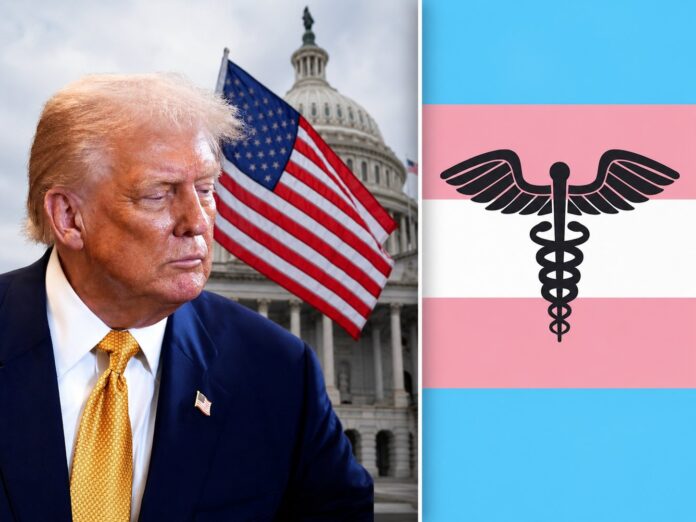
A US federal judge has struck down a Trump administration provision that threatened to make gender-affirming healthcare more expensive and difficult to access through some Affordable Care Act insurance plans.
On 14 August, Senior US District Judge Nathaniel Gorton ruled that the Department of Health and Human Services had acted unlawfully when it attempted to change which services could be classified as “essential health benefits” under the Affordable Care Act, commonly known as Obamacare.
The provision would have prevented certain forms of gender-affirming care from being treated as essential health benefits by non-grandfathered individual and small-group insurance plans.
Gorton vacated that section of the rule after finding the department had not followed the process required by Congress.
The ruling does not force every insurer to cover gender-affirming healthcare. However, it protects the ability for qualifying care to receive important Affordable Care Act financial protections in states and plans where it is covered.
For transgender people relying on marketplace insurance, that distinction can have a significant effect on affordability.
What The Trump Rule Would Have Changed
The provision formed part of the Trump administration’s 2025 Marketplace Integrity And Affordability Final Rule.
It sought to exclude specified gender-affirming procedures—which the administration described as “sex-trait modification procedures”—from the Affordable Care Act’s essential health benefit framework.
That would not necessarily have stopped insurers from covering the care altogether.
Insurers could still have chosen to offer coverage, while individual states could have required it under their own laws.
However, the care could no longer have been classified as an essential health benefit under the federal framework.
That would have removed important protections governing subsidies, patient cost-sharing and limits on what people can be required to pay themselves.
In practical terms, some transgender people could have faced significantly higher costs even if their insurer continued offering coverage.
Why Essential Health Benefits Matter
The Affordable Care Act requires many individual and small-group health plans to cover 10 broad categories of essential health benefits.
These include hospital treatment, prescription medicines, mental-health services, maternity care and preventive healthcare.
The framework was designed to stop insurers from marketing apparently affordable policies that exclude major areas of medically necessary treatment.
Services treated as essential health benefits can receive protections involving federal premium subsidies, cost-sharing reductions, annual out-of-pocket limits and restrictions on annual or lifetime dollar caps.
Removing gender-affirming healthcare from that framework could therefore have made access depend much more heavily on where a person lived, which insurer they used and whether they could afford additional costs.
The case demonstrates how a seemingly technical insurance classification can have serious consequences for patients.
HHS Failed To Follow The Required Process
Judge Gorton, who was appointed by Republican President George H.W. Bush, found that the Department of Health and Human Services could not alter the scope of the Affordable Care Act’s essential health benefit categories in the manner it had attempted.
The law establishes a process for making those changes, including reporting requirements and certification involving the Centers for Medicare and Medicaid Services’ chief actuary.
The department had not completed that process before introducing the gender-affirming-care restriction.
Gorton therefore ruled that the provision exceeded the department’s authority and violated federal administrative law.
The decision focused on how the rule was made. It did not require the court to decide broader questions about the medical effectiveness or appropriateness of gender-affirming healthcare.
Coalition Of States Challenged The Rule
The case was brought by a coalition of Democratic-led states and Pennsylvania Governor Josh Shapiro.
The plaintiffs challenged several sections of the Trump administration’s rule, arguing that the federal government had exceeded its legal authority and introduced changes that could increase insurance costs and reduce access to healthcare.
Gorton sided with the states over the gender-affirming-care provision.
However, the administration successfully defended four other provisions challenged in this part of the case.
That makes the decision a targeted legal victory rather than a wholesale rejection of the administration’s wider marketplace rule.
State Officials Welcome The Ruling
Officials involved in the case welcomed the decision as an important protection for transgender patients.
Massachusetts Attorney General Andrea Joy Campbell described it as a major victory for people who rely on gender-affirming healthcare, arguing that the blocked provision would have made treatment more expensive and less accessible.
Washington Attorney General Nick Brown similarly accused the federal government of unlawfully interfering with healthcare coverage residents had been promised under the Affordable Care Act.
For LGBTQ+ advocates, the ruling highlights how restrictions on transgender healthcare do not always arrive as explicit bans.
Access can also be limited through insurance classifications, funding rules and administrative decisions that determine whether people can afford treatment.
Gender-Affirming Care Remains A Political Target
The ruling comes amid a much broader campaign by the Trump administration to restrict gender-affirming healthcare across the United States.
Federal agencies have pursued policies affecting insurance coverage, hospital funding and healthcare provided to transgender young people.
The administration has also used federal funding and regulatory powers to pressure healthcare providers offering gender-affirming treatment.
Just days before Gorton’s ruling, the administration finalised another measure targeting federal Medicaid and Children’s Health Insurance Program funding connected to certain gender-affirming treatments for young people.
Those policies are expected to face further legal challenges.
The Affordable Care Act decision therefore blocks one route for restricting care, but it does not end the administration’s broader campaign against transgender healthcare.
A Significant Victory, But Not The End Of The Fight
The ruling is an important victory for transgender Americans who rely on Affordable Care Act plans, but access to gender-affirming healthcare remains deeply unequal across the country.
Some US states have enacted extensive protections for transgender patients and providers. Others have introduced restrictions or outright bans, particularly affecting trans young people.
That means someone’s ability to receive appropriate care can vary dramatically depending on where they live.
For LGBTQ+ communities in Australia, the case is also a reminder that healthcare access can be restricted through regulatory and funding decisions without governments introducing an explicit nationwide ban.
Australia has a very different healthcare and insurance system, but debates over public funding, clinical guidelines and access to gender-affirming services are increasingly politically charged here as well.
In the United States, this particular attempt to strip gender-affirming care of Affordable Care Act protections has now been stopped.
For transgender Americans, however, the wider fight for affordable, appropriate and accessible healthcare is far from over.
The news team for Gay Nation love tips from our readers. Got tips or a news story that you would like published? Go here to tell us something.
Visit the Gay Nation store Now