


















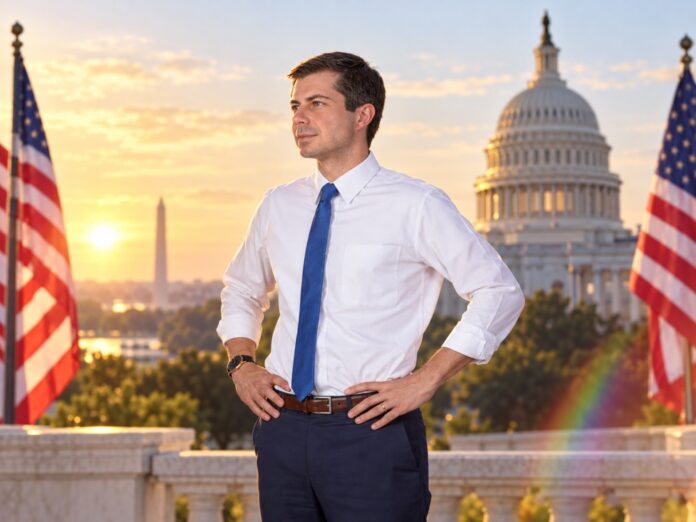
Pete Buttigieg says the United States was ready to elect a gay president when he launched his historic 2020 White House campaign—and remains ready today.
The former US Transportation Secretary was asked about running for the country’s highest office as an openly gay man during an interview with Kristen Welker on NBC’s Meet the Press.
“I wouldn’t have run for president in the first place if I didn’t believe that,” Buttigieg said.
Now considered a possible contender for the 2028 Democratic nomination, Buttigieg argues that voters are ultimately more interested in how a candidate will improve their lives than in that candidate’s sexuality.
Buttigieg Points To His Record In Indiana
Buttigieg said his political experience in South Bend, Indiana, gave him confidence that voters could look beyond his identity.
He came out publicly in June 2015 while seeking a second term as the city’s mayor.
Several months later, he was re-elected with just over 80 per cent of the vote.
That result came in Indiana, a socially conservative state that had been governed by future Trump vice-president Mike Pence.
Buttigieg told Meet the Press that his experience travelling across the country had reinforced the same conclusion.
In his view, voters are primarily thinking about their families, finances and futures—not the personal identity of the candidate standing before them.
That does not mean homophobia has disappeared from American politics.
It means Buttigieg believes sexuality does not have to prevent a candidate from building a winning coalition when voters see them as capable of addressing the issues affecting their lives.
His 2020 Campaign Made LGBTQ+ History
Buttigieg launched his first presidential campaign in 2019 while still serving as mayor of South Bend.
He entered a crowded Democratic field with limited national recognition but rapidly became a serious contender, raising significant campaign funds and performing strongly in televised debates.
His campaign reached a historic milestone during the 2020 Iowa Democratic caucuses.
Buttigieg narrowly led the official state-delegate-equivalent count, making him the first openly gay candidate to win a major-party US presidential nominating contest.
The result was complicated.
Bernie Sanders received more votes during both the first and final preference alignments, while Buttigieg finished fractionally ahead in the calculation used to allocate state delegates.
Even with that distinction, Buttigieg’s performance was unprecedented.
An openly gay candidate had not previously won a state-level contest in a major US presidential nomination campaign.
He ended his bid before Super Tuesday and endorsed Joe Biden, who went on to win the Democratic nomination and the presidency.
From Presidential Candidate To Cabinet Secretary
After Biden took office, Buttigieg became Transportation Secretary.
His confirmation made him the first openly gay person approved by the US Senate to serve in a presidential Cabinet.
The role gave him executive experience at the federal level and kept him visible as one of the Democratic Party’s most recognisable communicators.
He regularly appeared on television—including conservative outlets—to defend the administration’s infrastructure, transport and economic policies.
Buttigieg left the Cabinet when Donald Trump returned to the White House in 2025.
Since then, he has continued travelling across the country, campaigning for Democratic candidates and speaking about the party’s future.
He told Meet the Press that he had visited 35 states since leaving government.
Kamala Harris Considered Buttigieg As Her Running Mate
The question about America electing a gay president came amid renewed discussion of Buttigieg’s political future.
Former vice-president Kamala Harris has revealed that she seriously considered selecting Buttigieg as her running mate during her 2024 presidential campaign.
Harris described him as her preferred choice but concluded that asking voters to elect a Black woman as president and a gay man as vice-president on the same ticket presented too great a political risk.
That calculation has revived debate about how party leaders judge the supposed “electability” of candidates from minority communities.
Such decisions are rarely based solely on how voters have actually behaved.
They can also be shaped by assumptions about the prejudice campaign strategists expect voters to hold.
Buttigieg’s answer points back to his own electoral record: he came out while governing a city in conservative Indiana and subsequently won re-election in a landslide.
Is Pete Buttigieg Running In 2028?
Buttigieg has not announced another presidential campaign.
When pressed about 2028, he redirected attention towards the November 2026 midterm elections and the Democratic effort to regain control of Congress.
He has also repeatedly declined to rule out running.
His appearances in early presidential primary states, extensive national travel and continued media presence have ensured speculation remains intense.
Buttigieg would enter a future campaign with considerably more experience than he possessed in 2020.
He is now a former Cabinet secretary, an established national fundraiser and one of the Democratic Party’s most experienced television representatives.
He would also face a different political environment.
LGBTQ+ representation has grown across American public life, while anti-LGBTQ+ rhetoric—particularly attacks targeting transgender people—has become increasingly prominent in conservative politics.
A Buttigieg campaign would therefore test both the progress he believes America has made and the prejudice that remains.
Representation Does Not End With One Candidate
Electing an openly gay president would carry enormous symbolic significance.
It would show LGBTQ+ young people that sexuality does not automatically exclude them from the country’s most powerful office.
However, representation alone would not guarantee policies that protect every part of the LGBTQ+ community.
Queer voters would still need to examine Buttigieg’s positions on transgender rights, healthcare, discrimination, policing, foreign policy, economic inequality and other issues affecting their lives.
Being the first can matter enormously without placing a candidate beyond criticism.
Buttigieg’s central argument is not that voters should elect him because he is gay.
It is that they should not reject him for that reason.
The Question Resonates In Australia
America is not the only country yet to elect an openly LGBTQ+ national leader.
Australia has had openly queer ministers, senators and senior political figures, including Foreign Minister Penny Wong, but has never had an openly LGBTQ+ prime minister.
The country has also seen openly gay leaders at state and territory level, including longtime ACT Chief Minister Andrew Barr.
As in the United States, Australian LGBTQ+ candidates can still face disproportionate attention directed towards their relationships, families and identities.
Buttigieg’s argument therefore travels beyond American politics.
The real test of equality is not simply whether LGBTQ+ people are permitted to stand for office. It is whether voters and political parties can evaluate them according to the same standards applied to everyone else.
Could America Elect Its First Openly Gay President?
No openly gay candidate has yet won a major US party’s presidential nomination.
Buttigieg came closer than anyone before him, winning delegates, appearing on national debate stages and briefly becoming one of the strongest challengers in the Democratic field.
His 2020 campaign did not prove that sexuality had become irrelevant.
It did prove that an openly gay candidate could be treated as a serious contender for the White House.
Whether Buttigieg runs again in 2028 remains unanswered.
On the bigger question, however, he has no hesitation.
America, he believes, is ready.
The news team for Gay Nation love tips from our readers. Got tips or a news story that you would like published? Go here to tell us something.
Visit the Gay Nation store Now