












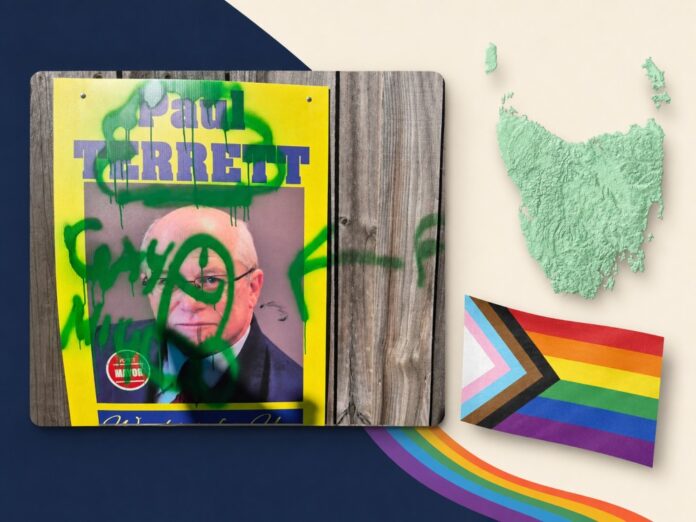
Campaign signs belonging to Tasmanian councillor Paul Terrett have been defaced with racist and homophobic slurs, prompting condemnation from Equality Tasmania and concerns that hate could discourage LGBTQ+ people from entering public life.
Two posters promoting the incumbent Northern Midlands councillor’s campaign for mayor were reportedly targeted.
The signs were covered with censored versions of the “f—” and “n——” slurs, alongside crude illustrations of genitalia.
The vandalism has been reported to Tasmania Police.
Equality Tasmania Condemns Anti-Gay Graffiti
Equality Tasmania spokesperson Rodney Croome said the attack demonstrated that legal equality had not eliminated anti-LGBTQ+ hatred.
“The anti-gay graffiti against Cr Terrett is a reminder that hate didn’t disappear with marriage equality,” Croome said. “This kind of graffiti will discourage LGBTQA+ people from standing for public office which will be a loss for the whole community.
“I urge community leaders to speak out against this attack to send a message hate is no longer acceptable. I also urge Northern Midlands Council to develop an LGBTIQA+ inclusion plan along similar lines to other Tasmanian councils.”
The use of homophobic language does not establish anything about Terrett’s sexuality.
Anti-gay slurs have frequently been used to intimidate or humiliate people regardless of their identity, reinforcing the wider idea that being perceived as LGBTQ+ is something shameful.
When combined with racist language and sexual imagery, the vandalism sends a broader message of hostility towards minority communities and anyone who does not conform to the perpetrator’s worldview.
Police Investigating Wider Graffiti Incidents
The signs were reportedly defaced during a series of graffiti incidents across Tasmania’s Northern Midlands overnight between 15 and 16 August.
Police are investigating the vandalism.
No arrest had been publicly announced at the time of publication, and there is currently no indication that Terrett was responsible for or connected to any of the offensive language displayed on the signs.
Terrett was elected to the Northern Midlands Council in 2022 and is campaigning to become mayor during Tasmania’s 2026 local government elections.
The elections will be conducted by postal ballot across all 29 of the state’s local government areas during September and October.
Hate Can Discourage LGBTQ+ Candidates
Croome’s warning extends beyond the damage done to two campaign posters.
Public displays of homophobia can make LGBTQ+ people question whether entering politics will expose them, their partners or their families to abuse.
That effect can be particularly pronounced at the local government level, where candidates are highly visible within relatively small communities and may encounter voters in their everyday lives.
When people from minority communities decide that running for office is not worth the personal risk, councils lose their experience and perspectives.
The result can be fewer people at the decision-making table who understand the barriers facing LGBTQ+, multicultural and other marginalised communities.
Tasmania’s Remarkable LGBTQ+ Transformation
The incident is particularly jarring in a state that has undergone one of Australia’s most significant transformations on LGBTQ+ rights.
Tasmania was the final Australian state or territory to decriminalise consensual sex between men, doing so in 1997 after years of activism and legal action.
It has since introduced several nationally significant LGBTQ+ reforms.
In 2025, Tasmania became the first Australian jurisdiction to provide financial redress to people charged or convicted under former laws criminalising homosexuality and so-called cross-dressing.
The state also pioneered the tourism inclusion program that has now evolved into the national Rainbow Ready Accreditation scheme.
First established by the Tourism Industry Council Tasmania in 2013, the program recognises tourism businesses committed to providing safe, welcoming and respectful experiences for LGBTQIA+ visitors.
Tasmania’s progress demonstrates how dramatically attitudes, laws and institutions can change.
However, the vandalism targeting Terrett’s campaign signs also shows that legislative reform does not automatically eliminate prejudice from the community.
Part Of A Wider Climate Of Concern
The Northern Midlands graffiti is not directly connected to other recent anti-LGBTQ+ incidents across Australia.
It nevertheless arrives amid heightened concern about hostility towards rainbow communities, particularly online and among groups targeting gay and bisexual men.
In July 2025, Melbourne LGBTQ+ venues The Laird and Eagle Leather were defaced with homophobic graffiti. Victoria Police subsequently released images of people they wished to identify in connection with that vandalism.
More recently, a Victorian parliamentary inquiry has heard evidence about organised attacks in which gay and bisexual men were allegedly lured through dating apps before being assaulted, robbed, threatened or filmed.
The inquiry was told that more than 95 reported attacks had been connected to this pattern, resulting in dozens of arrests.
Witnesses also raised concerns about online “manosphere” content combining homophobia with misogyny, racism, transphobia and far-right ideas.
Those violent cases are different in nature and severity from graffiti on campaign signs, and there is no evidence linking them.
Taken together, however, the incidents illustrate how anti-LGBTQ+ hostility can appear across a spectrum — from slurs and vandalism to intimidation and physical violence.
Graffiti Is More Than Property Damage
Campaign signs are routinely damaged during elections, sometimes through random vandalism or political disagreement.
The deliberate use of racist and homophobic slurs changes the character of the incident.
The words chosen communicate contempt not only towards the person depicted on the sign, but towards entire communities who recognise that language as having been used against them.
For LGBTQ+ people who have experienced bullying, rejection or violence, encountering those words displayed publicly can be confronting even when they are directed at somebody else.
Responding quickly and publicly therefore matters.
Removing the graffiti addresses the immediate damage. Condemnation from political, council and community leaders signals that the attitudes behind it are not accepted.
Equality Tasmania Calls For Inclusion Plan
Croome has urged the Northern Midlands Council to respond by developing an LGBTIQA+ inclusion plan similar to those adopted by other Tasmanian councils.
Such a move would create an opportunity for the council to work directly with local rainbow communities and consider how its services, facilities and policies can be more inclusive.
It would also transform an act intended to spread hostility into a catalyst for visible community support.
Marriage equality represented an extraordinary legal and cultural achievement for Australia.
But, as Croome noted, it did not make homophobia disappear.
The response to incidents like this will help determine whether hatred is allowed to intimidate people out of public life — or whether communities make it clear that everyone has a place in local democracy.
The news team for Gay Nation love tips from our readers. Got tips or a news story that you would like published? Go here to tell us something.
Visit the Gay Nation store Now