














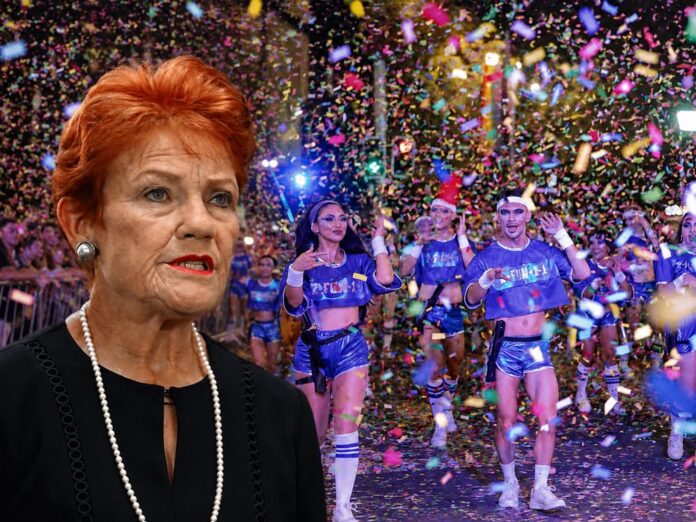
One Nation leader Pauline Hanson says she still dislikes the Sydney Gay and Lesbian Mardi Gras, standing by views she first expressed three decades ago despite acknowledging that Australia and its laws have changed significantly since then.
Her comments came amid controversy over former One Nation candidate Parminder Singh, who described homosexuality as a “mental illness” during an online interview.
Hanson quickly distanced herself from Singh’s remarks.
“He’s not standing for One Nation … they’re not my views,” she said.
However, when the conversation turned to her own record on LGBTQ+ issues, Hanson made clear that her opposition to Mardi Gras remained unchanged.
Pauline Hanson Distances Herself From Parminder Singh
Singh unsuccessfully contested an upper house seat at the 2025 Western Australian election and attracted widespread criticism after saying he did not believe people were born gay.
“No, no, it’s a mental illness,” Singh said during an interview with Perth content creator Jasky Singh, known as Mr Sikkant.
He also blamed parents for people being gay and criticised LGBTQ+ visibility and education.
Singh later apologised, saying he had repeated claims he encountered on social media and should not have presented them as fact.
“I’m sorry I hurt people,” he said.
“I should not have presented that as a fact. I respect everyone, and I believe every person in Australia should be free to live their life with dignity, equality and respect.”
Homosexuality is not considered a mental illness by recognised medical and psychological authorities and has not been classified as one for decades.
Despite his apology, Singh continued to oppose LGBTQ+ education and visibility, saying he did not support what he described as its “advertisement” or inclusion in primary schools.
One Nation’s Western Australian leadership also rejected his remarks, saying they did not reflect the party’s position.
Openly gay WA Labor minister John Carey was considerably more critical, arguing that the controversy reflected a broader pattern within One Nation rather than an isolated incident involving one former candidate.
Barnaby Joyce Calls One Nation One Of Australia’s ‘Gayest Parties’
The controversy took another turn when Barnaby Joyce, who joined One Nation in 2026, defended the party by describing it as “one of the gayest parties in Australia”.
Joyce pointed to openly gay people working within One Nation and said Singh’s comments did not reflect the party’s views.
When Hanson was later asked about Joyce’s description, she declined to embrace it.
“That’s Barnaby, and Barnaby is Barnaby,” she said.
“I know there are gay people that work for One Nation … and good on them.”
Hanson added that those people had earned their positions on merit and that their sexuality was “none of my business”.
One Nation national director James Ashby is openly gay and has worked closely with Hanson for many years.
However, the presence of openly gay people within the party has not prevented continued criticism of One Nation’s policies and rhetoric towards other parts of the LGBTQ+ community, particularly trans and gender-diverse Australians.
Hanson Still Opposes Mardi Gras
Hanson was then questioned about comments she made during a 1996 interview in which she criticised the Sydney Gay and Lesbian Mardi Gras.
At the time, she said she disliked the event because she believed it promoted something “not natural”.
Thirty years later, Hanson acknowledged that Australian society and the law had changed.
“The world has changed,” she said, pointing to the legalisation of marriage equality.
“Now that’s acceptable, and I’ve got no problem with it.”
Australia legalised same-sex marriage in 2017 following a national postal survey in which a clear majority voted in favour of changing the law.
Hanson said LGBTQ+ people should be free to live their lives as they choose.
However, that acceptance did not extend to Mardi Gras.
“Do I like the gay Mardi Gras? No … I still don’t like the gay Mardi Gras, but that’s my opinion,” she said.
When asked why, Hanson did not provide a detailed explanation.
“I just don’t like the gay Mardi Gras,” she repeated.
“Have I ever been to one? No. Do I intend to go? No, I don’t.”
‘Sexuality Should Be Kept Behind Closed Doors’
Hanson went on to argue that sexuality should remain private.
“Your own personal sexuality should be kept … behind closed doors,” she said.
“It’s no one’s business to do it out there with the gay Mardi Gras.”
For many LGBTQ+ Australians, that argument will feel deeply familiar.
Pride events such as Mardi Gras exist partly because queer people were historically expected to conceal their identities, relationships and affection from public life.
Sydney Gay and Lesbian Mardi Gras began as a protest movement in 1978, when participants marched for LGBTQ+ rights and were met with police violence and arrests.
It has since developed into one of the world’s most recognisable LGBTQ+ celebrations, bringing together protest, visibility, culture, community and plenty of sparkle.
Critics of the argument that sexuality should remain “behind closed doors” also note that heterosexual relationships are routinely visible throughout public life — from wedding announcements and family photographs to advertising, television and public displays of affection.
For many LGBTQ+ people, Pride is not about demanding special treatment. It is about having the same freedom to exist openly that heterosexual people regularly take for granted.
Hanson’s Recent Record On Trans Rights
Hanson’s latest comments came just two months after a National Press Club address in which she attacked transgender rights and organisations supporting LGBTQ+ communities.
During the June speech, Hanson described what she called a “transgender insurgency” and argued that what she labelled “transgender ideology” had influenced Australian institutions.
She also said she would sack Sex Discrimination Commissioner Anna Cody and Australian Human Rights Commission president Hugh de Kretser if One Nation formed government.
Her address included comments about transgender participation in sport, access to bathrooms and the involvement of LGBTQ+ organisations in public bodies and workplace inclusion programs.
The remarks were strongly criticised by LGBTQ+ organisations and advocates.
For Australia’s rainbow communities, Hanson’s latest comments present a complicated — and, for many, contradictory — position.
She now says she accepts marriage equality and does not care about the sexuality of people working within her party. At the same time, she continues to oppose one of Australia’s most visible LGBTQ+ celebrations and supports restrictions affecting trans and gender-diverse people.
Thirty years after first expressing her dislike of Mardi Gras, that part of Hanson’s position appears unchanged.
The news team for Gay Nation love tips from our readers. Got tips or a news story that you would like published? Go here to tell us something.
Visit the Gay Nation store Now