















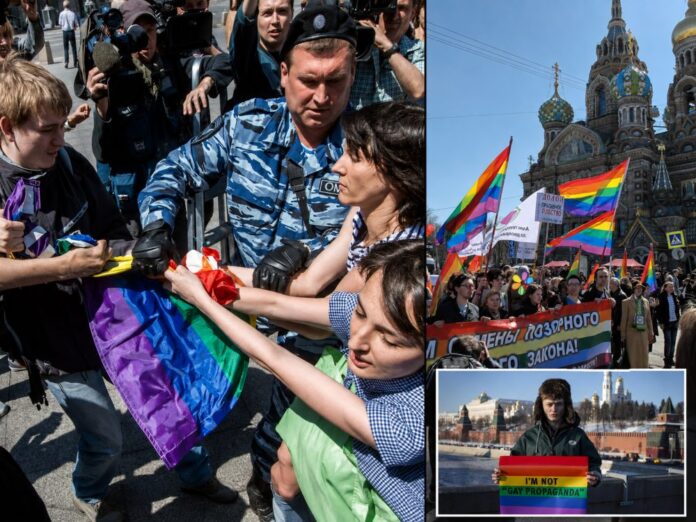
The Russian LGBT Network has announced it is shutting down after a St Petersburg court designated the organisation “extremist”, making its continued public operation too dangerous for staff, supporters and LGBTQ+ people seeking help.
The organisation said the ruling made its previous way of working impossible because “any connection to the organisation may create additional risks for the people we seek to support and protect”.
Its closure represents another devastating blow to LGBTQ+ people in Russia, where authorities have increasingly used extremism legislation to criminalise advocacy, visibility and support services.
Russian LGBT Network Puts Safety First
The Russian LGBT Network said it decided to close after undertaking a serious assessment of the risks facing everyone connected with its work.
Those potentially placed in danger included employees, volunteers, donors, partner organisations and people who had received legal, psychological or emergency assistance.
The network said it could not control Russia’s increasingly repressive environment but could avoid exposing people to further danger through continued public operations.
“People’s safety comes first,” the organisation said.
The decision was not presented as an admission of wrongdoing. Instead, it reflected the practical consequences of continuing to operate under a legal designation that could expose almost anyone associated with the organisation to criminal prosecution.
The network also acknowledged the activists and community groups it had brought together during nearly two decades of work, alongside the queer people it supported throughout Russia.
Court Declared Network ‘Extremist’ In April
The St Petersburg City Court declared the Russian LGBT Network an “extremist organisation” on 27 April following a lawsuit brought by Russia’s Justice Ministry.
The hearing was conducted behind closed doors, and the ruling imposed a nationwide ban on the network’s activities.
The organisation initially said it would appeal the decision and continue its work. However, the risks created by the designation ultimately made its public format impossible to maintain.
Under Russia’s criminal code, the consequences of association with an organisation designated “extremist” can be severe.
Participating in a banned organisation can carry a prison sentence of up to six years, while leading one can result in up to 12 years behind bars. Donations can be punished with sentences of up to eight years.
Repeatedly displaying symbols associated with a banned organisation — including logos or rainbow imagery interpreted by authorities as representing the supposed LGBTQ+ movement — can also result in criminal prosecution.
That means even publicly supporting the Russian LGBT Network, sharing its material or seeking help could potentially attract the attention of authorities.
Nearly Two Decades Of LGBTQ+ Support
Founded in 2006, the Russian LGBT Network became one of the country’s most prominent LGBTQ+ human-rights organisations.
It connected regional initiatives and activists, documented discrimination and violence, produced research and helped queer people access legal, psychological and social support.
The organisation was also internationally recognised for its emergency work assisting LGBTQ+ people facing immediate danger.
During the late 2010s, the network played an important role in helping queer people escape reported detention, torture and persecution in Chechnya.
Its work was particularly valuable outside Russia’s largest cities, where LGBTQ+ people could face isolation and have limited access to affirming legal advice, healthcare or community support.
Closing the organisation therefore affects more than one prominent name.
It removes a key part of the support network available to LGBTQ+ Russians at a time when those services are becoming increasingly dangerous to provide — and increasingly necessary.
Russia’s Expanding ‘Extremism’ Crackdown
The ruling against the Russian LGBT Network forms part of a much wider campaign targeting LGBTQ+ organisations and public visibility.
In November 2023, Russia’s Supreme Court declared the so-called “international LGBT movement” an extremist organisation and banned it.
No such organisation formally existed.
However, the deliberately vague designation gave authorities broad powers to treat LGBTQ+ advocacy, community organising, journalism and even displays of rainbow imagery as evidence of involvement in an extremist movement.
Human Rights Watch reported that courts across seven Russian regions banned nine LGBTQ+ organisations between March and May 2026.
Those targeted included Coming Out in St Petersburg, the LGBT Resource Centre in Yekaterinburg, the Moscow Community Centre for LGBT+ Initiatives, the transgender support organisation Centre T and queer media platform Parni+.
Human Rights Watch said Russian authorities were “intensifying their criminalisation” of organisations providing support to LGBTQ+ people.
The organisation called for the court decisions and criminal convictions based on what it described as spurious extremism allegations to be overturned.
LGBTQ+ Journalists Forced Into Exile
The crackdown has also targeted journalists reporting on queer lives.
Parni+, one of the largest Russian-language LGBTQ+ media outlets, was declared an extremist organisation in April.
Its journalists later said the remaining members of the team had been forced to leave Russia because continuing their work inside the country had become too dangerous.
The outlet’s designation demonstrated how the extremism framework extends beyond traditional advocacy organisations.
Reporting about queer relationships, discrimination, health and community life can now be treated as a threat to the state.
Publishers, bookstores, streaming platforms, bars and clubs have also faced raids, fines, criminal investigations and censorship over material or activities connected with LGBTQ+ people.
The result is not only the closure of organisations. It is the systematic removal of queer people from Russia’s public and cultural life.
Years Of LGBTQ+ Rights Being Dismantled
Russia’s current crackdown builds on more than a decade of increasingly restrictive legislation.
In 2013, the country introduced its original law banning so-called “propaganda of non-traditional sexual relationships” among minors.
The restrictions were expanded in 2022 to prohibit positive or neutral representations of LGBTQ+ identities among people of all ages.
Russia also introduced sweeping restrictions on gender-affirming healthcare and legal gender recognition before the Supreme Court’s 2023 extremism ruling dramatically widened the state’s ability to prosecute queer people and their supporters.
Since then, people have faced legal action over rainbow flags, social-media posts, group chats, books, films, private events and LGBTQ+ venues.
The extremism designation transformed expressions of identity and solidarity into potential evidence of criminal activity.
What The Closure Means For LGBTQ+ Russians
The closure of the Russian LGBT Network leaves a significant gap in legal assistance, crisis support and community organising.
For people facing violence, workplace discrimination, family rejection or prosecution, organisations such as the network could provide a vital connection to professional help and a route to safety.
Its closure may also make it harder for international human-rights bodies to understand the full scale of abuses taking place across Russia.
Community organisations frequently document cases that would otherwise remain invisible, particularly when victims fear reporting abuse directly to police or other state authorities.
The network’s disappearance from public life does not mean LGBTQ+ people in Russia no longer need support.
It means providing and receiving that support has become considerably more dangerous.
A Stark Warning For LGBTQ+ Australians
For LGBTQ+ communities in Australia, the closure is a stark reminder that the ability to organise, advocate and access community support cannot be taken for granted.
Queer organisations do far more than campaign for legislative change. They provide crisis assistance, health information, legal referrals, social connection and a sense of belonging to people who may have nowhere else to turn.
Russia’s crackdown demonstrates how quickly those services can be disrupted when governments deliberately portray LGBTQ+ identity and advocacy as threats to national values.
The Russian LGBT Network’s decision to close was made to protect people from prosecution — but it was the state’s actions that created that danger.
After nearly two decades of supporting queer people across Russia, an organisation established to protect vulnerable communities has itself been forced out of existence.
The news team for Gay Nation love tips from our readers. Got tips or a news story that you would like published? Go here to tell us something.
Visit the Gay Nation store Now