












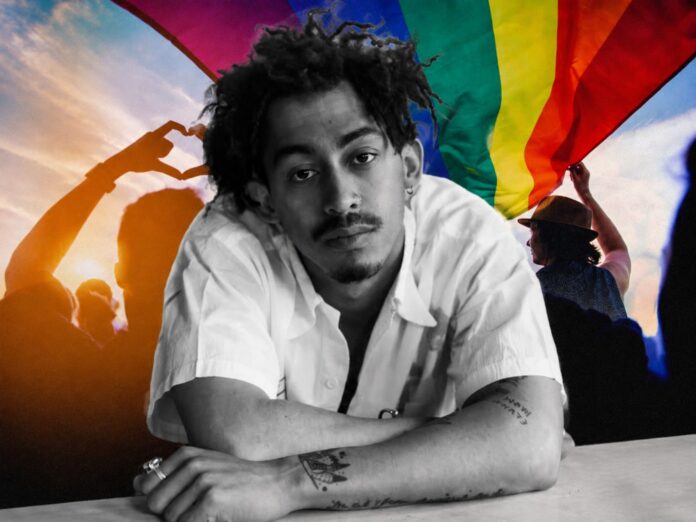
Jordan Stephens has challenged the double standard behind some straight men’s fear of being sexualised by gay men, after overhearing a man say he could not relax around them.
The musician, actor and longtime LGBTQ+ ally shared the encounter on the Miss Me? podcast with co-host Miquita Oliver while discussing why he enjoys spending time in queer venues.
Stephens said LGBTQ+ spaces give him a sense of freedom and joy that he does not always experience elsewhere, describing them as places where he can relax in a less judgemental environment.
Among the London venues he mentioned were Dalston Superstore and The Divine, both well-known queer nightlife spaces.
A conversation in the sauna
Stephens said the exchange took place in the sauna at his local gym.
After overhearing one man talking about enjoying a night out at a gay bar, Stephens joined the conversation and agreed that queer venues could often feel less aggressive than some traditionally straight nightlife spaces.
Another man then expressed discomfort at the possibility that gay men might be looking at him sexually.
“The thing is, when you’re in these spaces, I don’t know if I can relax ’cause I don’t know what they’re thinking,” Stephens recalled the man saying.
Stephens immediately challenged him.
“Yet you’re willing to be in a straight space where you’re doing the same thing to women,” he replied.
He said the exchange exposed a clear inconsistency: the man felt uncomfortable at the thought of being sexualised while willingly participating in spaces where women may regularly experience the same treatment.
“So you know that there’s a level of discomfort with experiencing the idea that you might be being sexualised, but you are willing to be the person doing it in a whole other space,” Stephens said.
What the exchange says about queer spaces
Stephens was not suggesting that everyone in a gay bar is automatically respectful, or that every straight venue is inherently unsafe.
Instead, his comments highlight a familiar reality for many LGBTQ+ people: queer venues can disrupt conventional expectations around gender, sexuality and masculinity.
Some straight men are accustomed to being the person doing the looking. Entering a space where they might instead feel watched or desired can suddenly make them aware of a discomfort many women experience in everyday social settings.
Stephens’ comments also challenge the idea that the mere presence of gay men makes a space inherently sexual or threatening.
That stereotype has long been used against LGBTQ+ people, particularly gay men, who have frequently been portrayed as predatory or incapable of respecting boundaries.
Attraction and inappropriate behaviour are not the same thing. Someone finding another person attractive does not entitle them to invade that person’s space, make unwanted advances or ignore their boundaries — regardless of their sexuality or gender.
Stephens says straight men can benefit from queer spaces
Stephens, best known as one half of British music duo Rizzle Kicks, has repeatedly spoken publicly in support of LGBTQ+ communities.
On 11 March 2026, he appeared at Trans Mission, a benefit held at Wembley in London in solidarity with trans people. The event raised money for the trans-led charity Not A Phase and the Good Law Project.
At the event, Stephens argued that straight men could benefit from spending more time in queer spaces — an idea closely connected to his sauna encounter.
Queer venues can allow people to experience environments where conventional ideas about masculinity, sexuality and who is expected to pursue whom are less rigid.
For straight allies, respectfully entering these spaces can also offer a deeper understanding of why dedicated LGBTQ+ venues remain so important.
Queer bars, clubs and community events have historically offered LGBTQ+ people somewhere to socialise, express affection and simply exist without constantly assessing whether their sexuality or gender identity could provoke hostility.
For Stephens, that freedom appears to be precisely what makes queer spaces worth seeking out.
Allyship that goes beyond words
Stephens has built a public reputation as an LGBTQ+ ally through both his advocacy and his appearances supporting queer and trans communities.
His participation in Trans Mission placed him alongside performers and speakers including Olly Alexander, Adam Lambert, Munroe Bergdorf and Sir Ian McKellen at an event explicitly organised around solidarity with trans people.
His latest comments present a simple challenge to straight men who feel uneasy in queer spaces: consider why the possibility of being looked at feels threatening, and whether that discomfort reveals something about how women and LGBTQ+ people are treated elsewhere.
For LGBTQ+ Australians, the importance of queer spaces will feel deeply familiar.
Across Australia, queer bars, clubs, sporting groups, festivals and community organisations provide opportunities for LGBTQ+ people to connect, celebrate and feel less alone. This can be particularly important in regional and rural communities, where dedicated queer spaces may be fewer and harder to access.
These spaces are not simply somewhere to drink or dance. They can offer a sense of belonging — places where people feel freer to flirt, express affection, build friendships and be themselves without having to explain or defend who they are.
Straight allies can absolutely be part of those spaces, but they should enter with respect and remember that they are guests in environments created primarily for LGBTQ+ people.
And, as Stephens suggests, straight men might learn something valuable from the experience.
The news team for Gay Nation love tips from our readers. Got tips or a news story that you would like published? Go here to tell us something.
Visit the Gay Nation store Now