












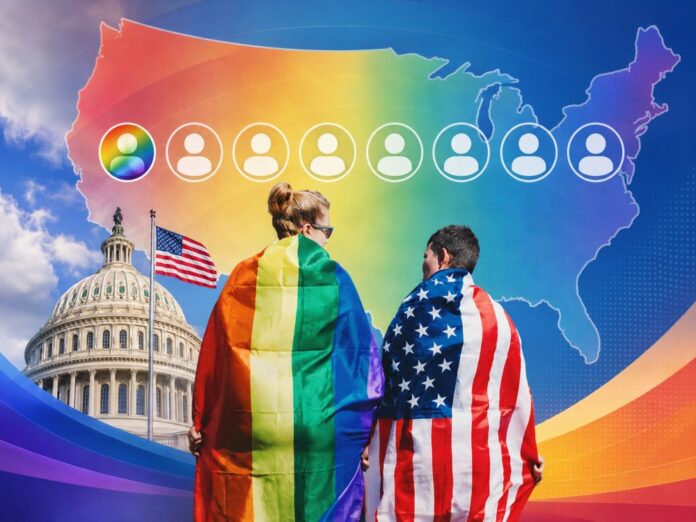
LGBTQ+ people make up an estimated 12% of the adult population in the United States, according to a major new analysis of US Census Bureau data.
The Human Rights Campaign Foundation estimates that approximately 25.6 million adults across the country identify as LGBTQ+ — a population larger than that of many nations.
The analysis drew on more than 2.4 million responses to the Census Bureau’s Household Pulse Survey, collected between 2021 and 2024.
HRC described the result as a record-high estimate of America’s LGBTQ+ population.
“LGBTQ+ Americans are everywhere,” HRC president Kelley Robinson said.
“There are 25 million of us across the country, and we now have critical mass in almost every state in the nation. We’re not a niche constituency, and no campaign, brand, or employer can afford to treat us like one.”
LGBTQ+ Americans Live Across The Entire Country
The analysis challenges the persistent assumption that LGBTQ+ Americans are concentrated primarily in progressive cities or traditionally queer-friendly states.
LGBTQ+ adults were estimated to make up more than 10% of the population in 40 of the country’s 50 states.
That included politically conservative and closely contested states such as Texas, Georgia and Arizona, as well as New Hampshire.
The results reinforce what LGBTQ+ advocates have argued for decades: queer and trans people live in every kind of community, including regional areas, religious communities and states where their rights remain heavily contested.
That geographic reach also gives LGBTQ+ Americans growing political, cultural and economic influence.
As Robinson noted, a community of more than 25 million people cannot credibly be dismissed as a small or specialised constituency.
Younger Adults Make Up A Significant Share
More than half of the LGBTQ+ adults identified in the analysis — approximately 53% — were aged between 18 and 34.
That reflects a broader generational trend seen across several major surveys.
Younger adults are considerably more likely to identify openly as LGBTQ+ than older generations, although researchers caution that this does not necessarily mean queer identities have suddenly become more common.
The increase may instead reflect younger people having greater access to language that describes their experiences, alongside growing social acceptance that makes them feel safer acknowledging their sexuality or gender identity.
Older LGBTQ+ people may also remain underrepresented in surveys because they grew up during periods when coming out carried greater legal, professional and personal risks.
Bisexual People Represent The Largest Group
Bisexual adults made up the largest section of the LGBTQ+ population identified in the analysis.
More than 7% of all US adults were estimated to be bisexual, meaning bisexual people represented a majority of the country’s wider LGBTQ+ population.
That finding is consistent with other research showing bisexual identity is particularly common among younger adults.
However, bisexual people can still face erasure and discrimination from both heterosexual and LGBTQ+ communities.
They may be assumed to be gay or straight depending on the gender of their partner, while their identity is sometimes dismissed as confusion or a temporary phase.
The scale of the bisexual population revealed by the analysis demonstrates why services, representation and policy discussions must include bisexual people rather than treating LGBTQ+ communities as exclusively gay and lesbian.
Racial Diversity Across LGBTQ+ Communities
The analysis also provided insight into the racial and ethnic diversity of LGBTQ+ America.
Hispanic adults accounted for approximately 18% of the LGBTQ+ population, compared with 13% of non-LGBTQ+ adults.
Black adults represented around 9% of the LGBTQ+ population and 12% of non-LGBTQ+ adults.
The results underline that LGBTQ+ identity exists across every racial and cultural community.
They also highlight the importance of recognising how racism, homophobia and transphobia can overlap, creating different experiences and barriers for LGBTQ+ people of colour.
Why Other Surveys Produce Different Numbers
A separate Gallup estimate published in February 2026 found that approximately 9% of US adults identified as LGBTQ+.
That figure was essentially unchanged from Gallup’s previous result of 9.3%.
The difference between Gallup’s 9% estimate and the HRC Foundation’s 12% figure does not necessarily mean one of the studies is incorrect.
The organisations analysed different datasets, covered different collection periods and used different survey methods and identity questions.
Gallup’s latest estimate was based on telephone interviews with more than 13,000 adults conducted during 2025. The HRC analysis used more than 2.4 million responses collected through the Census Bureau’s Household Pulse Survey between 2021 and 2024.
Differences in wording, methodology and whether people feel comfortable disclosing an LGBTQ+ identity can all affect the final result.
Both studies, however, support the conclusion that millions of LGBTQ+ people live throughout the United States and that younger adults are considerably more likely to identify openly as part of the community.
Federal Data Collection Is Being Rolled Back
The findings arrive amid growing concern about the Trump administration’s removal of sexual orientation and gender identity questions from federal surveys.
Research from the Williams Institute found that approximately 360 federal data collections had removed at least one measure relating to sexual orientation or gender identity since January 2025.
Most of the removed measures related to gender identity, although sexual orientation questions were also affected.
That makes the Household Pulse Survey data used by HRC particularly significant.
Without questions that allow LGBTQ+ people to identify themselves, researchers and governments have less information about disparities involving healthcare, employment, housing, violence and poverty.
Removing those questions does not make LGBTQ+ people disappear. It simply makes their experiences more difficult to measure — and easier for governments to ignore.
What The Findings Mean Beyond America
For LGBTQ+ communities in Australia, the precise US percentage is less important than the broader reality revealed by the data.
Queer and trans people are not confined to inner-city neighbourhoods, Pride festivals or traditionally progressive areas.
They live in cities, suburbs, regional towns and conservative electorates. They are workers, customers, voters, parents and community leaders.
That makes accurate data essential for governments, healthcare providers, businesses and community organisations attempting to understand who they serve.
The findings also challenge political campaigns that portray LGBTQ+ people as a tiny minority whose rights can be treated as a fringe concern.
Whether the most accurate estimate is 9% or 12%, tens of millions of LGBTQ+ Americans are living across every part of the country.
They are not going anywhere — and they are far from niche.
The news team for Gay Nation love tips from our readers. Got tips or a news story that you would like published? Go here to tell us something.
Visit the Gay Nation store Now