











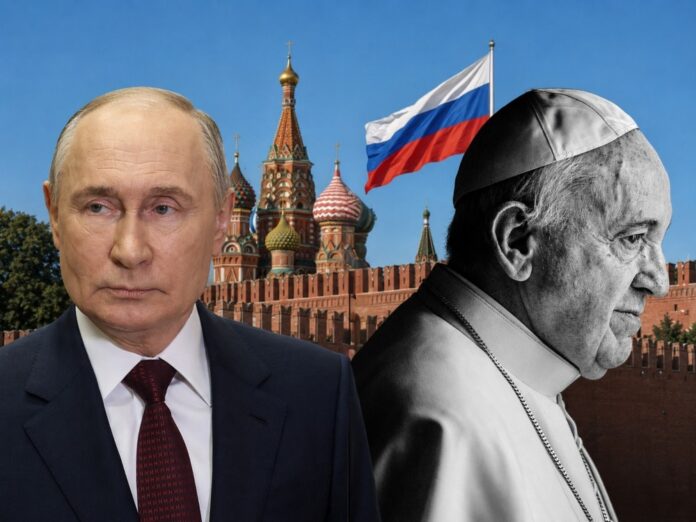
The Russian-language edition of Pope Francis’ autobiography has reportedly been censored to remove passages about gay and transgender people, including his condemnation of criminalising homosexuality.
Multiple sections of Hope: The Autobiography have been covered by solid black bars in the printed Russian edition, while the corresponding passages have been removed from the digital version.
The censored material includes Francis’ statements that gay and transgender people are welcome in the Catholic Church, that transgender people can be baptised and serve as godparents, and that homosexuality should not be treated as a crime.
The Russian edition was published by Alpina Publishing Group in 2026, more than a year after the book’s international release.
The publisher has not publicly explained why the passages were removed.
Black Bars Cover Pope Francis’ Words
Images of the censored pages were initially shared by Russian bookshop Primus Versus and subsequently circulated by independent media outlets.
The photographs show several blocks of text covered by thick black lines, making the censorship clearly visible to readers.
Theologian Natallia Vasilevich compared the Russian edition with the original text to establish what had been removed.
Among the missing passages was Francis’ statement that the Church should welcome gay and transgender people.
Also removed was his position that transgender Catholics can receive baptism and become godparents under the same conditions as other members of the Church.
Another censored passage discussed Francis’ opposition to laws criminalising homosexuality.
The late pontiff had previously said homosexuality was “not a crime, but a human reality”, while describing laws imprisoning people for consensual same-sex relationships as unjust.
Same-Sex Blessings Also Removed
The Russian edition also removes references to Fiducia Supplicans, the Vatican declaration that allowed priests to offer spontaneous, non-liturgical blessings to people in same-sex relationships.
Published in 2023 with Francis’ approval, the declaration represented a notable change in the Catholic Church’s pastoral approach.
It did not permit same-sex marriage or alter Catholic doctrine defining marriage as a union between a man and a woman.
It also did not approve a formal ritual for same-sex couples.
However, it allowed priests to offer informal blessings without demanding that people first prove they were living according to every aspect of Church teaching.
That distinction was significant for many LGBTQ+ Catholics who had long felt excluded from religious life.
Russian readers will not encounter Francis’ discussion of that development in the translated edition.
Pope Francis Had A Complicated LGBTQ+ Legacy
Francis adopted a more welcoming public tone towards LGBTQ+ people than many of his predecessors.
His “Who am I to judge?” response when asked about gay priests in 2013 became one of the defining statements of his papacy.
He repeatedly said the Catholic Church should be open to “everyone, everyone, everyone” and criticised families who rejected their children because of their sexuality.
Francis also condemned laws criminalising consensual same-sex relationships and approved the Vatican guidance allowing certain blessings for people in same-sex couples.
However, his record was not without serious contradictions.
Francis did not support marriage equality, maintained traditional Catholic teaching on sexuality and repeatedly criticised what he described as “gender ideology”.
He also faced criticism over language he reportedly used when discussing gay men in seminaries.
His papacy therefore did not deliver full equality within the Church. Nevertheless, his comments represented a meaningful shift in tone for many LGBTQ+ Catholics—and it is precisely those comments that have been removed from the Russian edition of his autobiography.
Did The Russian Government Order The Changes?
There is currently no public evidence showing that Russian authorities directly instructed Alpina Publishing Group to censor Francis’ book.
The publisher has not said whether the passages were removed following government intervention, legal advice or an internal decision intended to avoid prosecution.
That distinction is important.
While the Russian-language edition has clearly been censored, it remains unclear who made the final decision or whether a specific state agency demanded the changes.
However, publishers operating in Russia face sweeping laws targeting positive or neutral representations of LGBTQ+ people.
Those laws create powerful incentives for companies to censor material before authorities intervene.
The result can be a system in which the threat of prosecution achieves the same outcome as a direct government order.
Russia’s Expanding Anti-LGBTQ+ Censorship
Russia first introduced its federal law against so-called “gay propaganda” in 2013, initially claiming it was intended to protect minors.
In 2022, the restrictions were expanded to apply to people of all ages.
The law prohibits the promotion or positive representation of what authorities describe as “non-traditional sexual relations” and gender transition.
It has been used against books, films, television programmes, advertisements, social-media posts and public displays of rainbow imagery.
Russia’s Supreme Court further escalated the crackdown in 2023 by declaring the vaguely defined and effectively non-existent “international LGBT movement” an extremist organisation.
That ruling gave authorities significantly broader powers to target LGBTQ+ advocacy, community organising, symbols and public visibility.
People have since faced fines, detention and criminal investigation over rainbow flags, clothing, online content and alleged involvement in LGBTQ+ organisations.
Hundreds Of Books Have Disappeared From Sale
Russia’s publishing industry has been hit especially hard by the expanding censorship regime.
Since 2022, publishers and booksellers have removed or altered works containing LGBTQ+ characters, relationships or themes.
According to an investigation by independent Russian outlet The Insider, at least 600 books have disappeared from sale for censorship-related reasons.
That does not mean every title was subjected to a formal government ban.
Some were withdrawn by retailers, while others were edited, republished with sections removed or quietly made unavailable as companies attempted to avoid legal consequences.
More than 50 writers have also reportedly been designated “foreign agents”, while publishers and booksellers have faced both administrative and criminal cases.
The visible black bars across Francis’ autobiography now offer a particularly stark example of what that pressure looks like on the page.
Erasing LGBTQ+ People From Religious History
The censorship is especially striking because the removed passages concern whether LGBTQ+ people can belong within one of the world’s largest religious institutions.
Russia has not simply removed sexual material or explicit descriptions from the book.
It has removed statements about welcome, baptism, pastoral care and opposition to criminal prosecution.
For LGBTQ+ Catholics, those subjects can be deeply personal.
Many queer people remain active within faith communities while navigating institutions that have often treated their identities and relationships as incompatible with religious life.
Removing Francis’ words prevents Russian readers from encountering even his limited attempts to create a more welcoming Church.
For LGBTQ+ communities in Australia, the episode also demonstrates how censorship can reshape international history.
A translated edition may carry the same title, cover and author as the original while presenting readers with a substantially altered version of what that person believed.
Francis’ LGBTQ+ legacy was complicated and incomplete.
But Russian readers should still be allowed to encounter it for themselves—not be confronted by black bars where his words should be.
The news team for Gay Nation love tips from our readers. Got tips or a news story that you would like published? Go here to tell us something.
Visit the Gay Nation store Now